


Canadian Immigration Law
Weekly Digest | June 8, 2025
Key Highlights:
- Recent Judicial Reviews
- Bill C-3: Citizenship by Descent Reform Introduced
- Strong Borders Act Introduced
- British Columbia Targets U.S. Health Workers
- British Columbia Advances International Credential Recognition
- Manitoba Launches U.S. Health Worker Campaign
- Ontario Eases U.S. Health Worker Entry
- Québec Immigration Planning 2026–2029
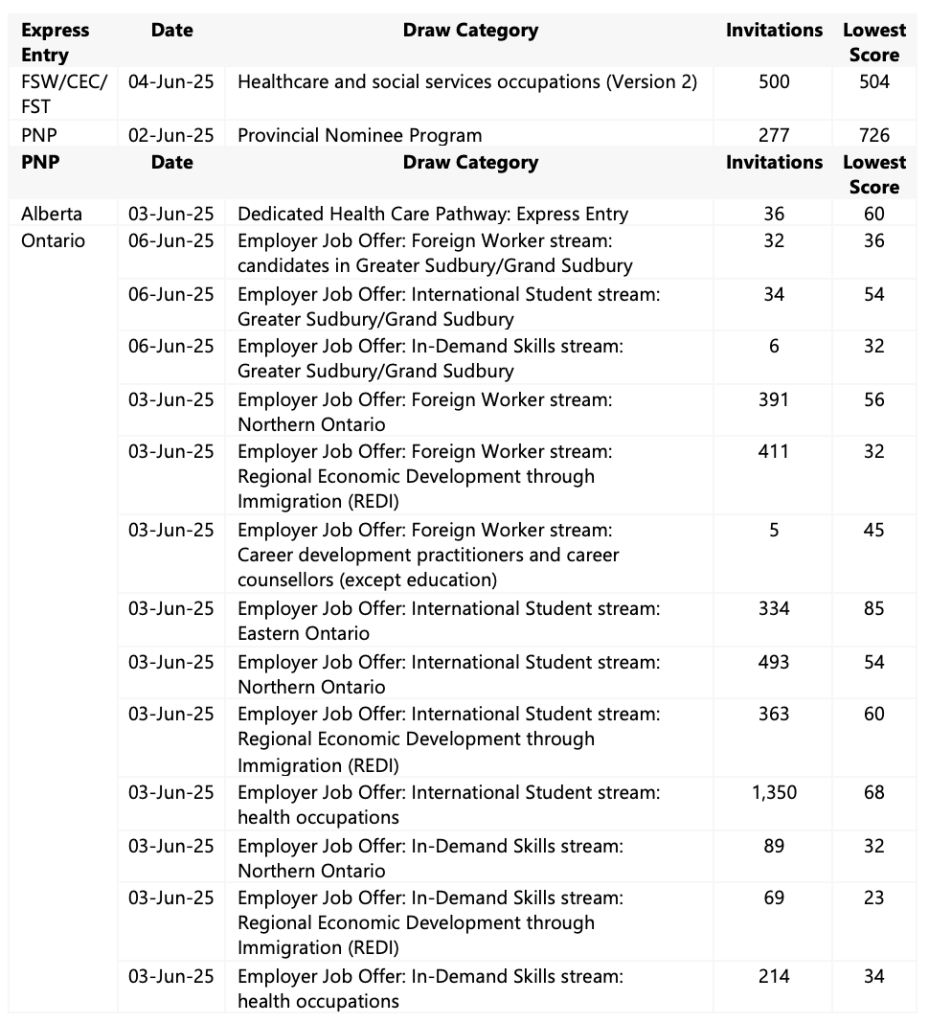
- Latest Express Entry & PNP Draw
- Important Upcoming Dates
Recent Case Law
- Study Permit – Aina v. Canada, 2025 FC 1009: Nigerian applicant was refused a study permit over financial concerns. Although he submitted proof that his father would sponsor his education, the officer questioned the relationship due to a name mismatch between the birth certificate and other documents. The Court held the officer breached procedural fairness by failing to raise the concern and allow a response. Judicial review granted. Read more
- Study Permit – Eisapour v. Canada, 2025 FC 1000: Iranian principal applicant sought to pursue a master’s program in Canada, accompanied by her spouse and daughter. The officer refused the application, citing weak ties to Iran and a study plan inconsistent with a temporary stay. The officer found no evidence of employer support or clear career benefit from the proposed studies. General references to entrepreneurship and advancement were too vague to support the stated objectives. The Court found the decision reasonable and supported by the record. Judicial review dismissed. Read more
- Temporary Resident Visa – Gupta v. Canada, 2025 FC 943: Indian applicant applied for a temporary resident visa to attend his sister’s call to the Bar. The officer refused the application due to insufficient financial evidence, including missing bank statements. The Court found the decision justified, noting the applicant bore the onus to establish financial capacity and failed to do so. Judicial review dismissed. Read more
- Express Entry – Braverman v. Canada, 2025 FC 1011: American national sought judicial review of IRCC’s alleged failure to issue him an invitation to apply for permanent residence under Express Entry, despite his claimed CRS score of 511. He argued that he should have received an invitation during a draw in October 2023. However, he filed no evidence of the draw, the CRS cutoff, or any communication from IRCC. The Court held there was no reviewable decision before it, as the application was based solely on unsubstantiated assertions. Read more
- Express Entry – Merijohn v. Canada, 2025 FC 1003: American applicant’s PR application was refused after the officer questioned whether his arranged employment qualified under NOC Major Group 00. Although the applicant submitted supporting documentation, the officer was not satisfied that he held a genuine senior management position, citing the lack of employees and organizational structure necessary for NOC 00013. The officer concluded the applicant was operating a small self-employed consulting business rather than occupying a senior executive role. The Court found the refusal justified and intelligible. Judicial review dismissed. Read more
- PNP – Misrepresentation – Minhas v. Canada, 2025 FC 990: The applicant was found inadmissible for misrepresentation based on concerns with address proximity to work, inconsistent bank records, questionable salary slips, and failure to disclose prior visa refusals. The Court upheld the first three findings but held the officer failed to assess whether the omission was an innocent mistake. Despite this flaw, judicial review dismissed as remaining grounds were sufficient. Read more
- Work Permit – TFWP – Pal v. Canada, 2025 FC 1008: Indian national was refused a work permit for a Food Service Supervisor position under the Temporary Foreign Worker Program. The officer expressed concerns about the applicant’s unrelated education, absence of proof of salary deposits, and insufficient evidence of qualifying work experience. The Court held that the officer failed to meaningfully assess the evidence or justify why the documentation provided was inadequate. Judicial review granted. Read more
- Open Work Permit – Singh v. Canada, 2025 FC 944: Indian applicant sought an open work permit as the spouse of a study permit holder. The application was refused for insufficient proof of accessible funds. However, the officer failed to consider fixed deposit certificates showing $20,000 in the applicant’s name. The Court found this omission rendered the decision unreasonable. Judicial review granted. Read more
- C11 Work Permit – IMP – Zare v. Canada, 2025 FC 1014: Iranian national applied to extend his work permit as a self-employed entrepreneur under R205(a) (C11). The officer concluded that the business did not provide ongoing benefit to Canada, as the applicant remained the sole employee and submitted no evidence of future hiring. The officer also found that the applicant failed to establish the temporary nature of his stay, including ties to his home country. The Court held that the officer was not required to seek out evidence from a prior application, as the applicant bore the obligation to submit a complete application. Judicial review dismissed. Read more
IRCC News Updates
- Bill C-3: Citizenship by Descent Reform Introduced: On June 5, 2025, the federal government introduced Bill C-3 to eliminate the first-generation limit on citizenship by descent. The bill would restore citizenship to those affected by outdated provisions and create a new framework allowing Canadians born abroad to pass on citizenship if they have at least 1,095 days of physical presence in Canada before their child’s birth or adoption. An interim measure remains in place while the bill moves through Parliament. Read more Backgrounder: Read more Bill C-3 First Reading: Read more
Public Safety Canada
- Strong Borders Act Introduced: On June 3, 2025, the federal government introduced the Strong Borders Act, proposing expanded authority for IRCC to share client data, suspend or cancel immigration documents, and pause application intake in the public interest. The bill also seeks to streamline asylum processing and introduces two new ineligibility rules: claims made more than one year after first arrival in Canada (post–June 24, 2020), and claims made over 14 days after irregular U.S. land entry, would not be referred to the IRB. Read more Backgrounder: Read more
Provincial Government News
- British Columbia Targets U.S. Health Workers: On June 2, 2025, British Columbia launched a six-week U.S. recruitment campaign aimed at doctors, nurses, and allied health professionals in Washington, Oregon, and California. Ads in medical journals and 14,000 digital locations direct candidates to explore jobs and relocation support via Health Match BC. U.S.-trained professionals will benefit from faster registration, with nurses now able to register in days and streamlined licensing underway for physicians. Read more
- British Columbia Advances International Credential Recognition: On June 6, 2025, B.C.’s Office for International Credential Recognition released its first annual report, highlighting progress under the International Credentials Recognition Act, which took effect July 1, 2024. Regulators in 29 professions are aligning with the law to streamline licensing. As of July 1, 2025, Canadian work experience requirements must be replaced with alternate assessments or exemptions. Read more
- Manitoba Launches U.S. Health Worker Campaign: On June 4, 2025, Manitoba launched a recruitment campaign targeting health professionals in Michigan, Minnesota, North Dakota, and South Dakota. The campaign highlights Manitoba’s public, inclusive, patient-focused health-care system—emphasizing affordability, community, and evidence-based care including women’s and gender-affirming health. Read more
- Ontario Eases U.S. Health Worker Entry: On June 5, 2025, Ontario announced that U.S.-licensed doctors and nurses can now work in the province for up to six months without prior registration, while seeking Ontario licensure. This measure, part of Ontario’s broader health workforce plan, expands practice settings beyond hospitals and long-term care, removes mobility barriers, and complements efforts to retain local talent. U.S. professionals must still meet immigration and public protection requirements. Read more
- Québec Immigration Planning 2026–2029: On June 5, 2025, Québec launched consultations on proposed immigration targets for 2026–2029, including a 13% reduction in temporary immigration (TFWP, ISP) and three scenarios to lower permanent admissions to between 25,000–45,000 annually. New priorities favour French-speaking candidates already in Québec. PSTQ invitations begin July 2025. Intake under PEQ (graduate and worker streams) is suspended until November 30, 2025. Collective Sponsorship Program remains suspended until December 31, 2027. Read more
Latest Draws
Important Upcoming Dates
- June 28, 2025: Alberta’s 13-member advisory committee will submit its report on improving foreign credential recognition to the Minister of Immigration and Multiculturalism. Read more
- June 30, 2025: Temporary suspension of new applications under the Québec Graduate stream and invitations under the Regular and Skilled Worker Selection Programs remains in effect until this date. Read more
- July 11, 2025: Updated unemployment rates for census metropolitan areas (CMAs) take effect and will be used to assess Labour Market Impact Assessment (LMIA) refusals for low-wage positions in regions with unemployment rates at or above 6%. Read more
- July 31, 2025: Temporary public policy ends for Israeli nationals and Palestinian passport holders in Canada, allowing fee-exempt applications for status extensions, study permits, or open work permits. Read more
- July 31, 2025: Temporary public policy ends for eligible family members of Canadian citizens and permanent residents who left Israel or the Palestinian Territories on or after October 7, 2023, allowing fee-exempt applications for status extensions, study permits, or open work permits in Canada. Read more
- July 31, 2025: Temporary special measures end for eligible Lebanese nationals in Canada and family members of Canadians or permanent residents who left Lebanon, allowing fee-exempt applications for open work permits, study permits, or status extensions. Read more




 AVIO Immigration