


Canadian Immigration Law
Weekly Digest | March 23, 2025
Key Highlights:
- Recent judicial reviews
- Canada invests $9.3M in Francophone minority communities
- Citizenship ceremony on International Francophonie Day
- Canada invests $52M to fast-track credential recognition in healthcare and construction
- Canada Child Benefit for Temporary Residents (March 2025)
- Temporary residence support for in-Canada applicants with pending PR applications
- Permanent residence pathway for new out-of-status applicants
- Home Care Worker Immigration Pilots (2025–2030)
- Home Care Worker Immigration (Child Care) Class (2025–2030)
- Home Care Worker Immigration (Home Support) Class (2025–2030)
- Parents and Grandparents Program (PGP) 2025 Intake
- Alberta opts out of temporary work permit policy
- Alberta and Express Entry profile updates
- Alberta end the family connection and occupation in demand pathway
- Yukon opens request period for support letters
- Updated forms and checklists
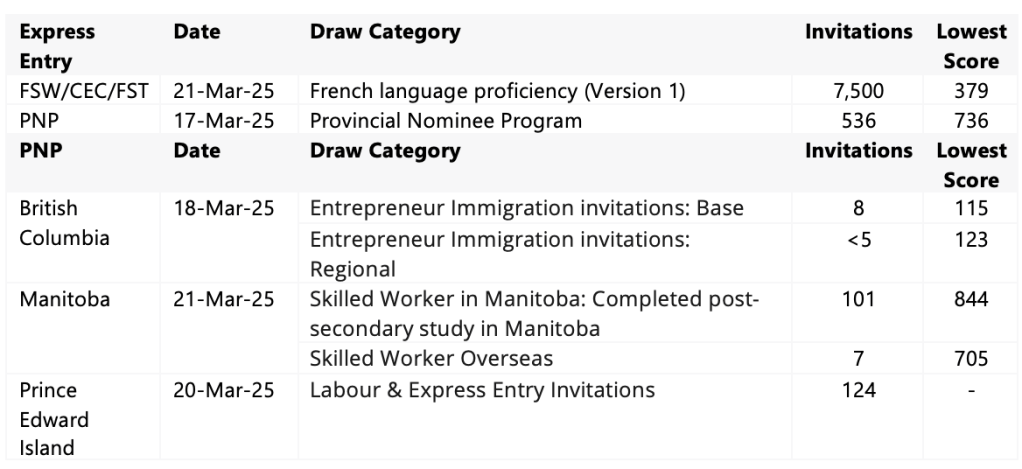
- Latest Express Entry and PNP draws
- Important upcoming dates
Recent Case Law
- Humanitarian & Compassionate – Alkalheh v. Canada, 2025 FC 438: Jordanian citizen of Palestinian origin, applied for PR from within Canada on H&C grounds. She arrived in Canada in 2016 and filed her application in 2022, citing her inability to regularize her status in Kuwait, potential discrimination in Jordan, and establishment in Canada. The officer found insufficient evidence of hardship upon return to either Kuwait or Jordan, discounted her establishment in Canada, and considered the best interests of her children. The Court found thee officer’s decision reasonable and consistent with the evidence. Judicial review dismissed. Read more
- Study Permit – Ayoade-Odebode v. Canada, 2025 FC 525: Nigerian applicant was refused a study permit for a Graduate Diploma in Accounting at UBC. The officer found insufficient proof of financial sufficiency and source of funds under IRPR s. 220, and was not satisfied she would leave Canada. The applicant alleged unreasonableness and procedural unfairness. The Court upheld the decision, confirming officers may assess both adequacy and provenance of funds, and no duty arose to invite further docs. Judicial review dismissed. Read more
- Temporary Resident Visa – Dubale v. Canada, 2025 FC 510: Ethiopian citizen applied for a TRV to accompany her Canadian-born children to Canada for a three-month stay, citing the need for one child’s open-heart surgery. The officer refused the application under IRPR s. 179(b), citing insufficient funds, lack of proof of temporary intent, absence of supporting medical documentation, no evidence of medical insurance, and the applicant’s prior removal from Canada. The Court held the officer’s concerns were reasonable. Judicial review dismissed. Read more
- Humanitarian & Compassionate – Francois v. Canada, 2025 FC 514: Grenadian citizen applied for PR under H&C grounds, citing over 20 years in Canada and the best interests of her Canadian-born son. The officer unreasonably applied the minority test from Kanthasamy, requiring an exceptional threshold, and failed to assess the applicant’s personal circumstances with empathy. The decision reused boilerplate language from prior refusals and did not consider the impact of removal adequately. The Court found the decision unreasonable. Judicial review granted. Read more
- Start-Up Visa – Le v. Canada, 2025 FC 499: Group of applicants from Vietnam and India were refused PR under the Start-Up Visa Program. The officer found the business commitment primarily aimed at acquiring status under IRPA s. 89(b). Concerns included unclear ownership structure, minimal growth over three years, limited engagement in Canada, reliance on foreign entities, and vague financial projections. The Court held the officer’s reasoning was justified and the decision reasonable. Judicial review dismissed. Read more
- Misrepresentation – Muaca v. Canada, 2025 FC 534: Angolan citizen found inadmissible for submitting an inauthentic South African police certificate in support of a work permit application. The Court upheld the decision, finding the applicant failed to demonstrate that the misrepresentation was an innocent mistake. Judicial review dismissed. Read more
- Temporary Resident Permit – Ocran v. Canada, 2025 FC 522: Ghanaian citizen overstayed her study permit and applied for a TRP to remain eligible for a post-graduate work permit. The officer refused the application without addressing key evidence, including community support, a job offer, and COVID-19-related barriers to compliance. The Court held that the officer failed to engage with the applicant’s central submissions and evidence. Judicial review granted. Read more
- Canadian Experience Class – Express Entry – Zuhair Shihab v. Canada, 2025 FC 482: U.S. citizen applied for permanent residence under the Express Entry Canadian Experience Class but failed to click “submit” on a required form. The application was deemed incomplete. The officer refused reconsideration, and the Court found the refusal reasonable, noting there was no longer a pending application under section 12 of the IRPR. Judicial review dismissed. Read more
IRCC News Updates
- Canada invests $9.3M in Francophone minority communities: On March 20, 2025, the federal government announced funding for 12 projects under the Francophone Immigration Support Program to promote economic development and demographic growth in Francophone minority communities. The initiatives, led by the Centre for Innovation in Francophone Immigration, aim to improve recruitment, selection, and settlement of French-speaking applicants and support their pathway to permanent residence. Targets for French-speaking permanent residents outside Quebec will rise to 8.5% in 2025, 9.5% in 2026, and 10% in 2027. Read more
- Citizenship ceremony on International Francophonie Day: On March 20, 2025, the Honourable Rachel Bendayan, in her first citizenship ceremony as Minister of Immigration, Refugees and Citizenship, welcomed 64 new Canadians from 31 countries at a special event in Ottawa marking International Francophonie Day. Read more
ESDC News Updates
- Canada invests $52M to fast-track credential recognition in healthcare and construction: On March 20, 2025, the Government of Canada announced up to $52 million in funding for 16 projects through the Foreign Credential Recognition Program to support the labour market integration of internationally trained professionals. The investment will improve credential recognition systems, reduce assessment times, and expand access to Canadian work experience, with a focus on healthcare and construction. Over 4,600 participants are expected to benefit directly, addressing critical shortages and supporting economic growth. Read more Backgrounder: Read more
Taxpayers’ Ombudsperson Report
- Canada Child Benefit for Temporary Residents – March 2025: The Taxpayers’ Ombudsperson released Timing Is Everything, highlighting systemic issues in Canada Child Benefit (CCB) delivery to temporary residents. Key findings include benefit interruptions due to CRA delays in processing immigration status updates and lack of notification when payments stop. The CRA currently relies on manual updates and has no information-sharing agreement with IRCC. The report makes 11 recommendations, including automating updates, improving communication, providing online tools, and establishing a data-sharing agreement with IRCC to ensure timely access to CCB for eligible temporary residents. Read more
Temporary Public Policies
- Temporary residence support for in-Canada applicants with pending PR applications: Effective March 31, 2025, a temporary public policy allows certain out-of-status or unauthorized home care workers in Canada, who have already submitted a permanent residence application under Stream A of the Home Care Worker (Child Care or Home Support) Class and are seeking exemptions under the related PR policy, to restore temporary resident status and apply for a work or study permit while awaiting a decision. In-Canada family members may also benefit. This public policy will remain in effect for five years. Read more
- Permanent residence pathway for new out-of-status applicants: Also effective March 31, 2025, a public policy enables up to 280 new permanent residence applications from out-of-status or unauthorized home care workers in Canada under Stream A (140 in each of the Child Care and Home Support streams). The policy exempts eligible principal applicants and their accompanying family members (in Canada or abroad) from certain inadmissibility provisions and program requirements. Intake closes once the cap is reached or by December 31, 2025, whichever occurs first. Read more
Canada Gazette
- Home Care Worker Immigration Pilots (2025–2030): Ministerial Instructions set annual intake caps for Child Care and Home Support classes. For 2025–2026: 2,610 apps/class; from 2026–2030: 2,750 apps/class. Stream A only until 2027, then Streams A & B split by online/alternate methods. Excess apps returned with fees. Applies only to complete PR apps under s. 10 IRPR. Effective March 31, 2025, to March 30, 2030. Canada Gazette, Part I, Volume 159, Number 12: Read more
- Home Care Worker Immigration (Child Care) Class (2025–2030): Ministerial Instructions establish permanent residence pathways under Stream A (in-Canada workers) and Stream B (others), requiring CLB 4, post-secondary education, 6+ months recent work experience or qualifying full-time in-person training, and a genuine job offer in NOC 44100 (excluding foster parents). Applicants must have funds equal to half the Low Income Cut-Off. Effective for five years beginning March 31, 2025. Canada Gazette, Part I, Volume 159, Number 12: Read more
- Home Care Worker Immigration (Home Support) Class (2025–2030): Ministerial Instructions set permanent residence criteria under Stream A (in-Canada workers) and Stream B (others), requiring CLB 4, post-secondary education, 6+ months recent full-time work experience or qualifying in-person training in NOC 33102 or 44101, and a genuine job offer outside Quebec. Applicants must also show funds equal to half the Low Income Cut-Off. Valid for five years from March 31, 2025. Canada Gazette, Part I, Volume 159, Number 12: Read more
- Parents and Grandparents Program (PGP) 2025 Intake: Ministerial Instructions authorize up to 25,000 sponsorship applications received in 2024 and 2025 to be processed in 2025. Invitations were based on 2020 interest-to-sponsor submissions using a randomized selection. Applications must be submitted online unless an exception applies, and must meet all documentary, procedural, and deadline requirements. PR applications must be tied to an approved sponsor. H&C requests submitted with applications not accepted under these Instructions will not be processed. These Instructions repeal the January 4, 2025 version and take effect upon signature. Canada Gazette, Part I, Volume 159, Number 12: Read more
Provincial Government News
- Alberta opts out of temporary work permit policy: Alberta will not participate in the federal Temporary Public Policy to Facilitate Work Permits for Prospective Provincial Nominee Program Candidates in 2025, citing limited allocations and economic constraints. Read more
- Alberta and Express Entry profile updates: Expired or soon-to-expire Express Entry profiles must be updated proactively to meet Alberta Advantage Immigration Program criteria. Read more
- Alberta end the family connection and occupation in demand pathway: As of March 17, 2025, Alberta Advantage Immigration Program will no longer invite candidates under this pathway. However, applicants can still claim points for having a qualifying family connection (parent, sibling, child) in Alberta who is a Canadian citizen or permanent resident over 18 under the Expression of Interest System launched September 2024. Read more
- Yukon opens request period for support letters: From March 19 to April 2, 2025, foreign nationals in Yukon with valid work permits as of May 16, 2024, may request a support letter for a Yukon-specific work permit (valid up to two years). Employers must plan to nominate them under the Yukon Nominee Program in 2025 or 2026. This temporary measure, in effect until December 31, 2025, allows continued work while transitioning to permanent residency. Intake process details to be announced. Read more
Updated Forms and Checklists
- IMM 0267: Employment Information Form – Individual Employer – Home Care Worker Immigration Pilots: Read more
- IMM 0268: Employment Information Form – Business Employer – Home Care Worker Immigration Pilots: Read more
- IMM 0270: Document Checklist – Home Care Worker Immigration Pilots – Workers in Canada stream: Read more
- IMM 0271: Schedule 21 – Home Care Worker Immigration Pilots: Read more
- IMM 0272: Schedule 22 – Home Care Worker Immigration Pilots – Public Policy: Read more
- IMM 0273: Document Checklist – Home Care Worker Immigration Pilots – Workers in Canada – Public Policy: Read more
Latest Draws
Important Upcoming Dates
- March 24, 2025: Public consultation closes on proposed regulatory amendments to the Provincial Nominee Program (PNP), which aim to streamline processing by removing federal duplication in assessing a nominee’s economic establishment and intent to reside. Canada Gazette, Part I, Volume 159, Number 8: Read more
- March 31, 2025: Ukrainians and their family members in Canada under CUAET can access free settlement services until this date. Read more
- March 31, 2025: Launch of the new Home Care Worker Immigration Pilots. Read more
- April 1, 2025: Foreign worker recruiters in PEI must be licensed, with eligibility limited to lawyers, notaries, or registered immigration consultants, requiring a $100 fee and a $10,000 security deposit to enhance worker protections and ensure fair treatment. Read more
- April 1, 2025: Expired Refugee Protection Claimant Documents (RPCDs) will no longer be valid, and asylum claimants must submit renewal applications or request replacements for lost, destroyed, or stolen RPCDs using IRCC’s web form. Read more
- April 2, 2025: Deadline to request a letter of support under Yukon’s extended work permit measure for foreign nationals with expiring permits, tied to future nomination under the Yukon Nominee Program. Read more








 AVIO Immigration