

Canadian Immigration Law
Weekly Digest | October 27, 2024
Key Highlights:
- Recent Immigration Case Law
- 2025–2027 Immigration Levels Plan
- Temporary Foreign Worker Program Reforms
- Immigration Loan Program – Methods of Payment
- Bilingual Remarks/Observations for Visitor Records, Work Permits, and Study Permits
- Study Permits – Attestation Letters Update
- Ontario Policies for International Medical Trainees
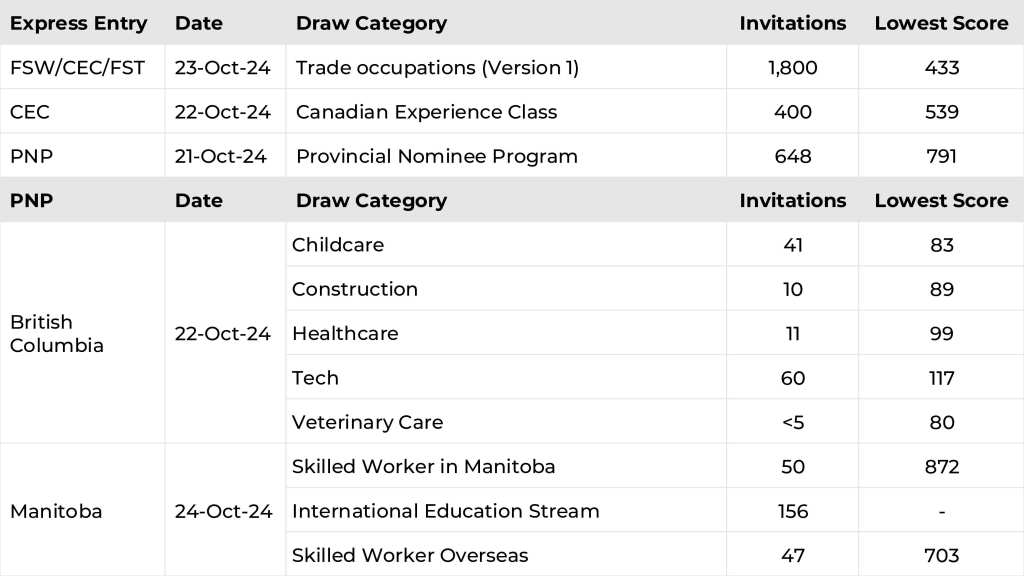
- Latest Express Entry and PNP Draws
Recent Case Law
- Humanitarian & Compassionate – Arruda v. Canada, 2024 FC 1691: A Portuguese citizen applied for permanent residence on humanitarian and compassionate grounds, citing her establishment in Canada and the best interests of her Canadian-born son, as well as concerns over adverse conditions and risks from her ex-spouse in Portugal. Judicial review granted. The court found the decision unreasonable due to inadequate consideration of the child’s best interests. Read more
- Study Permit – Boukani v. Canada, 2024 FC 1652: An Iranian citizen applied for a study permit to pursue an MBA in Canada, intending to bring her family. The officer questioned her ties to Iran and doubted the relevance of her studies due to her previous education in a different field. Judicial review was granted as the court found the assessment unreasonable, failing to consider her professional background and purpose for studying in Canada. Read more
- PR Travel Document – Hassani v. Canada, 2024 FC 1668: Iranian citizens applied for PR travel documents after an extended period abroad, which were refused due to their failure to meet residency requirements. Humanitarian and compassionate grounds were also not accepted. Judicial review was dismissed. The court found that the Immigration Appeal Division (IAD) reasonably applied the hardship test and appropriately excluded a best-interests analysis for their adult children, given no evidence of special dependency. Read more
- Inadmissibility – Karimi v. Canada, 2024 FC 1674: An Iranian citizen was found inadmissible for misrepresentation after submitting bank statements that appeared fraudulent in a work permit application. Judicial review was dismissed, as the court found the officer’s decision reasonable, deeming the omitted and altered financial information material to the application. Read more
- Post-Graduate Work Permit – Khullar v. Canada, 2024 FC 1655: An Indian citizen’s post-graduate work permit application was refused due to a lapse in full-time student status during the Winter 2020 semester. Judicial review was dismissed as the court upheld the officer’s decision, affirming that the strict criteria for the PGWP based on continuous enrollment were reasonably applied, and that the Winter 2020 semester was not the applicant’s final term, as required for part-time exceptions. Read more
- Inadmissibility – Samra v. Canada, 2024 FC 1649: An Indian citizen was found inadmissible for misrepresentation after failing to disclose a recent U.S. entry refusal, which he claimed was an innocent error. Judicial review dismissed. The court upheld the officer’s decision, finding that the omission was material to the application and constituted misrepresentation. The court also dismissed the applicant’s procedural fairness claim, noting that the officer provided sufficient opportunity for response. Read more
IRCC News Updates
2025–2027 Immigration Levels Plan: Read more
Supplementary Information: Read more
Speaking Notes: Read more
Backgrounder: Read more
- Permanent Resident Targets Reduced: Canada has reduced annual permanent resident targets to 395,000 for 2025, 380,000 for 2026, and 365,000 for 2027. These reductions support sustainable population growth and are expected to help narrow Canada’s housing supply gap by about 670,000 units by 2027.
- Economic Immigration: By 2027, economic immigration will constitute 62% of all permanent resident admissions, focusing on sectors such as healthcare and trades under the “Federal Economic Priorities” stream. Special emphasis is on in-Canada transitions for skilled temporary residents, particularly through the Canadian Experience Class, Provincial Nominee Programs, and other regional streams.
- Family and Humanitarian Streams: The family stream will remain at 22% of total admissions to support family reunification, while the refugee and protected persons category will constitute 15%, reflecting Canada’s ongoing commitment to vulnerable populations, even with overall target reductions.
- Francophone Immigration Outside Quebec: Francophone immigration targets for regions outside Quebec are set to increase to 8.5% in 2025, 9.5% in 2026, and 10% in 2027, supporting the growth and vitality of French-speaking communities nationwide as per Canada’s Francophone Immigration Policy.
- Temporary Resident Caps Introduced: New caps limit temporary residents, with targets set at 673,650 in 2025, reducing to 516,600 in 2026 and slightly increasing to 543,600 in 2027. Temporary resident volumes will reach no more than 5% of Canada’s population by 2026 to reduce pressure on housing and public services.
- Priority for In-Canada Transitions: In 2025, over 40% of permanent resident admissions will be allocated to temporary residents already in Canada, minimizing additional demand on housing and social resources by prioritizing those already settled.
- Limited Regularization for Essential Workers: A targeted regularization pathway will be available for undocumented workers in essential sectors, permitting a select group to apply for permanent residency. No broad regularization program will be implemented.
ESDC News Updates
Temporary Foreign Worker Program Reforms: Read more
- Wage Increase for High-Wage Stream: Effective November 8, 2024, wages for high-wage stream positions will increase by 20% above the provincial or territorial median, adding $5-$8 per hour depending on location.
- Expansion of Low-Wage Stream Requirements: More jobs will shift to the low-wage stream, which includes stricter employer obligations for housing, transportation, and prioritizing domestic recruitment.
- Business Legitimacy Proof Changes: From October 28, 2024, attestations from accountants or lawyers will no longer be accepted to verify business legitimacy. Enhanced data-sharing with provinces and territories will further validate employer credentials.
- Ongoing Compliance Monitoring: The government will maintain active monitoring for misuse and fraud, with adjustments to be made as needed to ensure only genuine employers with verified labour needs can access the program.
Program Delivery Updates
- Immigration Loan Program – Methods of Payment: On October 21, 2024, IRCC has revised the Immigration Loan Program guidelines to provide clients with detailed instructions on available payment methods and loan collection procedures. Read more
- Bilingual Remarks/Observations for Visitor Records, Work Permits, and Study Permits: On October 22, 2024, IRCC has introduced a Bilingual User Remarks reference table for IRCC and CBSA officers. This table enables easy access to standardized bilingual remarks for various conditions and categories. Read more
- Study Permits – Provincial or Territorial Attestation Letters Update: As of October 23, 2024, IRCC has revised study permit instructions to align with Ministerial Instructions 75 (MI75), updating terminology from “provincial attestation letter” to “provincial or territorial attestation letter” (PAL/TAL). Changes include the removal of two exceptions, the addition of new exceptions, and further examples of documentary evidence for proof of exception. Read more
Provincial Government News
- Ontario Policies for International Medical Trainees: As part of broader changes to medical education policy, Ontario is reviewing the visa trainee program for international students in Ontario’s medical schools who are sponsored by foreign governments. This review is aimed at protecting training capacity for Ontario students, aligning with new requirements that mandate 95% of medical school seats be reserved for Ontario residents starting in 2026. The policy shift reflects Ontario’s commitment to strengthening local healthcare infrastructure by increasing support for Ontario residents and limiting the influx of foreign-sponsored international students in medical programs. Read more
Express Entry and PNP Draws
Important Upcoming Dates
- October 31, 2024: Deadline extended for Yukon Nominee Program applicants to request work permit support letters for permits expiring after May 16, 2024, or before December 31, 2024. Read more
- October 31, 2024: Consultation period closes for public feedback on the Canada-United States-Mexico Agreement (CUSMA), aimed at refining its effectiveness for the 2026 joint review and the 2025 CUSMA Free Trade Commission meeting. Read more
- October 31, 2024: Validity ends for previously issued Educational Credential Assessments (ECAs) for architects (NOC 21200) by bodies other than the Canadian Architectural Certification Board (CACB). Read more
- November 1, 2024: New language and field of study requirements for graduates applying for the Post-Graduation Work Permit (PGWP) come into effect. Read more; Speaker Notes: Read more; Backgrounder: Read more; New Eligibility Criteria: Read more
- November 19, 2024: Temporary policy for Haitian nationals in Canada offering fee-exempt extensions and permits expires. Read more
- November 19, 2024: Policy granting fee-exempt extensions, work, and study permits to Haitians in Canada expires. Read more
- November 19, 2024: Policy for family of Canadian citizens/permanent residents who fled Haiti expires, ending fee-exempt permits. Read more
- November 23, 2024: Québec graduates seeking permanent selection under the Québec Experience Program must meet new French language criteria, including 75% of courses in French or three years of full-time education in French. Read more
- November 29, 2024: Amendments to Québec’s Qualified Worker Selection Program (QWSP) Stream 3 for regulated professions require proof of recognition or admission before applying, with a one-year application deadline. Read more
- November 30, 2024: Alberta Advantage Immigration Program (AAIP) will stop accepting open work permits for wildfire-affected individuals transitioning from employer-specific permits under special measures. Read more






 AVIO Immigration