

Canadian Immigration Law
Weekly Digest | September 1, 2024
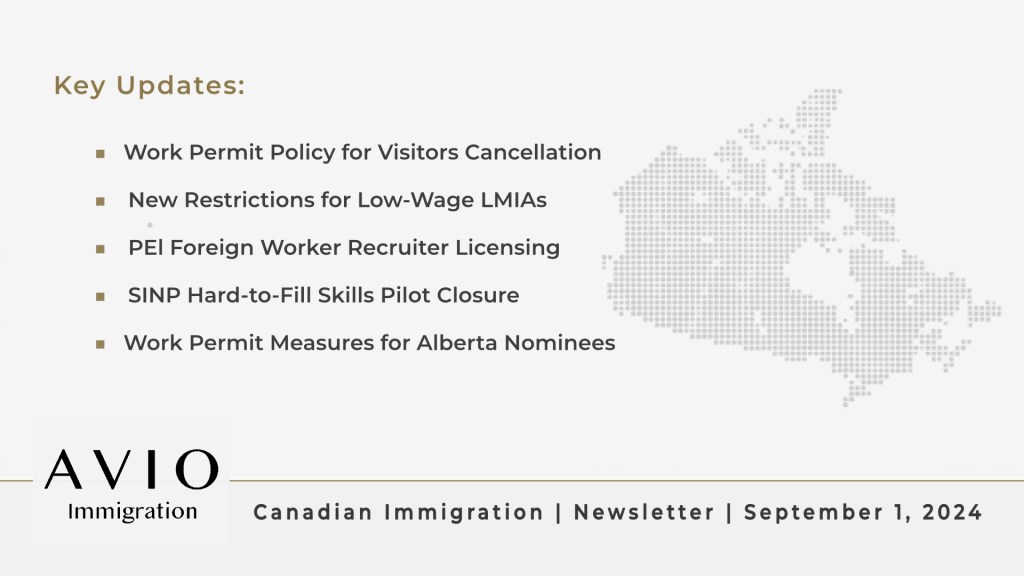
Key Highlights:
- Recent Immigration Case Law
- Expired Refugee Protection Claimant Documents
- End of Work Permit Policy for Visitors
- New Restrictions for Low-Wage LMIAs
- Ongoing Monitoring and Adjustments to the TFWP
- Processing In-Canada Claims for Refugee Protection
- Ukraine – General Processing
- Post-March 31, 2024 Measures for Ukrainians
- Temporary Work Permit Measures for Alberta Nominees
- Newfoundland and Labrador: Newcomer Settlement and Integration Grants
- PEI Foreign Worker Recruiter Licensing
- Closure of Hard-to-Fill Skills Pilot In Saskatchewan
- New Immigration Streams for Agriculture and Health Care Workers in Saskatchewan
- New Policy for Provincial Nominee Program Candidates
- Latest Express Entry and PNP Draws
Recent Case Law
- C11 Work Permit: In Savehshemshaki, 2024 FC 1313, the Federal Court dismissed the judicial review of an Iranian national’s self-employed work permit application for a ski instruction business in Toronto. The application was denied as the officer concluded the business would not significantly benefit the economy or targeted groups such as immigrant youth and minorities. The court found no errors in the officer’s analysis of job creation estimates and competitive factors within Toronto’s market, agreeing that the business plan lacked detail on targeting and sustaining operations beyond the applicant’s initial involvement. Read more
- C11 Work Permit: In Shahryaranbardan, 2024 FC 1314, the Federal Court dismissed the judicial review concerning the applicant’s application for a work permit to establish a clothing business in Canada. The application was refused based on inadequate English language skills and insufficient financial documentation to support the business’s viability. The court noted the applicant’s evidence of only 96 hours of English training was insufficient for the communication demands of business management. Read more
- IMP Work Permit: In Wu, 2024 FC 1344, the Federal Court granted the judicial review of the applicant’s work permit application, initially denied due to perceived insufficient English reading skills. The applicant’s English IELTS scores were 5.5 overall, with 4.5 in reading, exceeding the Saskatchewan Immigrant Nominee Program (SINP)’s minimum requirement of CLB 4. The court deemed the decision to deny based on reading skills as unreasonable and lacking justification, leading to a remand for reevaluation by a different officer. Read more
IRCC News Updates
- Expired Refugee Protection Claimant Documents: Effective April 1, 2025, expired refugee protection claimant documents (RPCDs) will no longer be valid. Asylum claimants must apply to renew expired RPCDs or replace lost, destroyed, or stolen ones using IRCC’s web form. Old paper forms will not be processed and will be returned. Renewed RPCDs will be mailed or made available for pickup at local IRCC offices. Read more
- End of Work Permit Policy for Visitors: Effective immediately, IRCC has terminated the temporary public policy that allowed visitors to apply for work permits within Canada. Initiated in August 2020 due to COVID-19 travel restrictions, this policy enabled visitors and those who had held a work permit in the past 12 months to apply without leaving Canada. Applications submitted before August 28, 2024, will still be processed under the policy. Read more
ESDC News Updates
- New Restrictions for Low-Wage LMIAs: Effective September 26, 2024, the government will not process Labour Market Impact Assessments (LMIAs) in low-wage streams for areas with unemployment rates of 6% or higher, except in critical sectors like agriculture, food, and healthcare. Further, the cap on temporary foreign workers per employer is set at 10%, and the maximum employment duration in low-wage streams is reduced to one year (from two years). These measures, responsive to the current labor market conditions, aim to recalibrate the use of temporary foreign workers in Canada. Read more
- Ongoing Monitoring and Adjustments to the TFWP: The Government of Canada will continue to assess labour market conditions and adjust the Temporary Foreign Worker Program as necessary. Over the next 90 days, a review may lead to changes in the High-Wage Stream, adjustments for unfilled LMIA applications, modifications to sectoral exceptions, or refusing to process other LMIA applications, including those for rural areas. Read more
Program Delivery Updates
- Processing In-Canada Claims for Refugee Protection: Effective August 29, 2024, updated procedures require that ineligible claimants, who are still eligible for a pre-removal risk assessment, must now receive the refusal letter alongside the Refugee Protection Claimant Document (RPCD). These changes impact post-interview processing and the final decision-making process for in-Canada claims for refugee protection. Read more
- Ukraine – General Processing: As of August 29, 2024, the processing guidelines for Ukraine have been revised to remove the reassessment criteria in medical examinations. Additionally, the instructions now include updated information on refunds, reflecting the approval of a remission order for previously paid fees. Read more
- Post-March 31, 2024 Measures for Ukrainians: Effective August 1, 2024, extended measures are in place for Ukrainians and their families following the end of CUAET. This includes support for CUAET visa holders issued visas on or after February 4, 2024, but could not travel to Canada by March 31, 2024. Ukrainians who applied for a CUAET visa by July 15, 2023, but did not receive a decision by February 4, 2024, can now receive facilitated entry, apply for fee-exempt permits, and extend their stay until December 31, 2024. Read more
Provincial Government News
- Temporary Work Permit Measures for Alberta Nominees: Effective August 26, 2024, Alberta Opportunity Stream and Rural Renewal Stream nominees may receive support for a two-year open work permit from IRCC under the Temporary Public Policy for Provincial Nominee Program Candidates. This policy applies to those awaiting decisions or whose applications were declined due to expired permits in 2024, between May 7 and December 31. Eligible candidates will be directly contacted by the AAIP and must have maintained status or be eligible for restoration. Read more Policy: Read more
- Newfoundland and Labrador: Newcomer Settlement and Integration Grants Call for Proposals: The Department of Immigration, Population Growth and Skills invites proposals for the Newfoundland and Labrador Settlement and Integration Grants program. This initiative supports newcomer integration across social, economic, and cultural dimensions. Proposals prioritizing direct settlement services, labour market attachment, and economic immigration are encouraged. Eligible entities include non-profits, post-secondary institutions, municipalities, and Indigenous Governing Bodies. Read more
- PEI Seeks Public Feedback on Foreign Worker Recruiter Licensing: The Government invites public input on new draft regulations under the Temporary Foreign Worker Protection Act, requiring licensing for foreign worker recruiters. This initiative aims to protect temporary foreign workers and ensure fair treatment. The Act, passed in spring 2022, now includes detailed licensing requirements. Following the consultation, which ends on September 19, 2024, recruiters in PEI will need to apply for a licence, unless exempt. Read more
- Closure of Hard-to-Fill Skills Pilot In Saskatchewan: Effective August 30, 2024, the Hard-to-Fill Skills Pilot will be permanently closed, but applications still in process with a valid Candidate-Specific Job Approval Letter will be completed. The Saskatchewan Immigrant Nominee Program (SINP) will host information sessions on alternative pathways on September 6 and 11, 2024, at 9:00 a.m. Read more
- New Immigration Streams for Agriculture and Health Care Workers in Saskatchewan: Released on August 30, 2024, Saskatchewan has introduced two new talent pathways under the SINP for the agriculture and health care sectors. The Agriculture Talent pathway will enhance production capabilities and global food security contributions, while the Health Talent Pathway aligns with the Health Human Resources (HHR) action plan to improve health care recruitment and services. Read more
Temporary Public Policies
- New Policy for Provincial Nominee Program Candidates: Announced on August 27, 2024, this temporary public policy facilitates open work permits for eligible foreign nationals who are part of Provincial Nominee Programs. To qualify, candidates must hold an employment offer, possess a valid work permit or have held one that expired on or after May 7, 2024, and must have a support letter from their residing province or territory. This letter should detail their placement in an Expression of Interest pool or other application inventory process following an initial provincial or territorial assessment. This policy remains in effect until December 31, 2024, but may be revoked at any time. Read more
Express Entry and PNP Draws

Important Upcoming Dates
- September 1, 2024: Changes to the Post-Graduation Work Permit Program include ineligibility for students in curriculum licensing arrangements and eligibility for a three-year work permit for master’s graduates. Read more PDI: Read more
- September 3, 2024: ESDC implements six-month freeze on processing low-wage LMIAs in Montréal economic region for positions offering wages below $27.47/hour, excluding agriculture, construction, food processing, education, and health and social services. Read more
- September 30, 2024: Alberta Advantage Immigration Program introduces a new expression of interest system. Read more
- September 30, 2024: Deadline for ESDC Online Questionnaire on Strengthening Workforce. Read more Questionnaire: Read more
- October 10, 2024: Upcoming draws for the Saskatchewan Immigrant Nominee Program (SINP) Entrepreneur Category. Read more
- October 27, 2024: Extension period ends for support measures for family members who fled Sudan due to conflict since April 15, 2023. Read more; PDI: Read more; Policy: Read more
- October 31, 2024: Consultation period closes for public feedback on the Canada-United States-Mexico Agreement (CUSMA), aimed at refining its effectiveness for the 2026 joint review and the 2025 CUSMA Free Trade Commission meeting. Read more
- October 31, 2024: Validity ends for previously issued Educational Credential Assessments (ECAs) for architects (NOC 21200) by bodies other than the Canadian Architectural Certification Board (CACB). Read more







 AVIO Immigration