

Canadian Immigration Law
Weekly Digest | August 25, 2024
Key Highlights:
- Recent Immigration Case Law
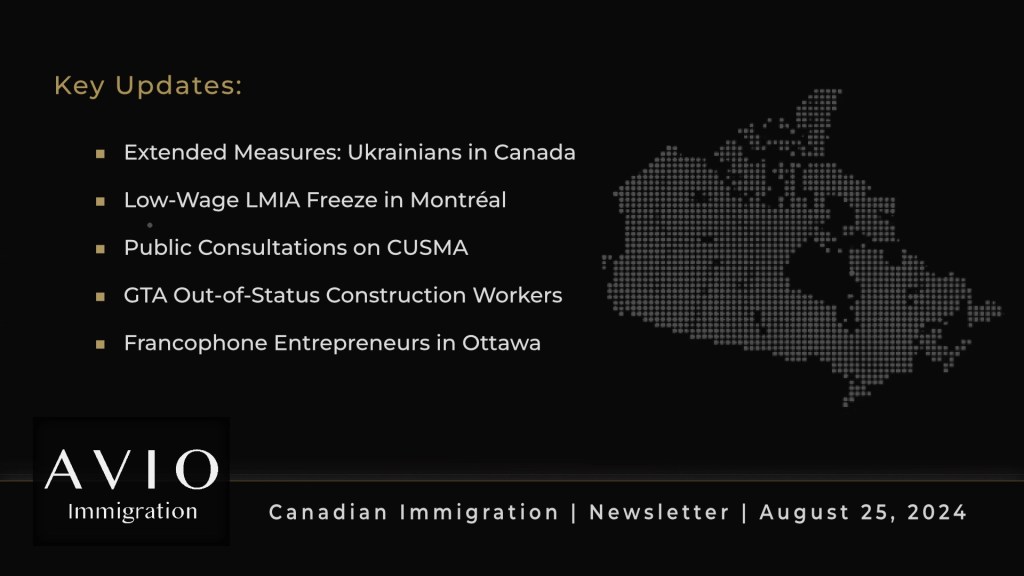
- Extended Measures for Ukrainians in Canada
- Low-Wage LMIA Freeze in Montréal
- Public Consultations on CUSMA
- SUV Program Peer Review Pause
- GTA Out-of-Status Construction Workers Program Extension
- Updates for Diplomatic Personnel
- Francophone Entrepreneurs in Ottawa
- New Internal Review Process for OINP Applicants
- Study Permit Application Cap and Attestation Requirement
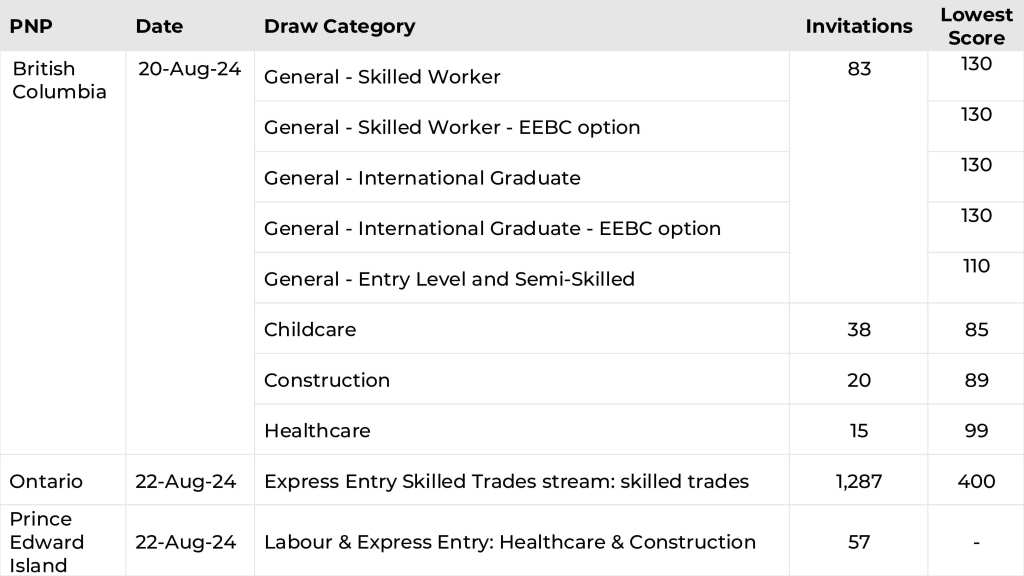
- Latest PNP Draws
Recent Case Law
- Minor Study Permit: In Janaghaei, 2024 FC 1289, the Federal Court dismissed the judicial review of a decision to refuse a study permit for the applicant, a teenager from Iran who sought to attend high school in Canada. The visa officer refused the application on the grounds that the applicant did not provide sufficient evidence to prove he would leave Canada at the end of his studies, citing an incomplete custodianship declaration, a lack of detailed study plans, missing academic transcripts, and concerns about the financial support for his studies. The Court upheld the officer’s decision, finding it reasonable and procedurally fair. Read more
- Post-Graduate Work Permit: In Kaur, 2024 FC 1311, the Federal Court dismissed the judicial review of a decision to refuse the applicant’s PGWP application. The refusal was based on the applicant’s failure to apply within the required 180-day period and her attempt to restore worker status, despite never having held such status previously. The Court upheld the officer’s decision, finding it reasonable and procedurally fair. Read more
- Misrepresentation: In Reyes Garcia, 2024 FC 1303, the Federal Court granted the judicial review of a decision that found the applicant inadmissible for misrepresentation. The applicant, a Mexican citizen, was deemed inadmissible for not disclosing a prior criminal charge in his electronic travel authorization (ETA) application. During a later interview at a Canadian port of entry, he initially denied the charge but changed his answer after a Spanish interpreter was involved. The officer based the decision on this inconsistency and the absence of a federal Mexican police certificate. The Court found the decision unreasonable due to the officer’s mischaracterization of prior findings and failure to consider the applicant’s affidavit, which clarified the misunderstanding. Read more
IRCC News Updates
- Extended Measures for Ukrainians in Canada: As of August 23, 2024, Ukrainians and their family members who arrived in Canada under the Canada–Ukraine authorization for emergency travel on or before March 31, 2024, can apply for an open work permit valid for up to 3 years until March 31, 2025. They may also extend their current open work permit or apply for a new study permit, subject to standard fees. Additionally, all Ukrainian temporary residents and their families in Canada can access free settlement services until March 31, 2025. Read more Public Policy for CUAET Extension: Read more Public Policy for Continued Access to Work and Study Permits for Ukrainians in Canada: Read more
ESDC News Updates
- Low-Wage LMIA Freeze in Montréal: Starting September 3, 2024, the Government of Canada, in response to a request from Quebec, will temporarily suspend processing new Labour Market Impact Assessment (LMIA) applications for low-wage positions in the Montréal economic region offering wages below $27.47/hour. This six-month freeze does not apply to LMIAs submitted before September 3, 2024, or to jobs in specific sectors such as agriculture, construction, food processing, education, and health and social services. The policy aims to ensure the TFW Program is used only when no qualified Canadian workers are available. Read more
Global Affairs
- Public Consultations on CUSMA: On August 21, 2024, Global Affairs Canada launched public consultations to gather Canadians’ views on the Canada-United States-Mexico Agreement (CUSMA). These consultations aim to assess the agreement’s effectiveness and identify areas for improvement. Feedback will guide Canada’s priorities for the first joint review of CUSMA in 2026 and the 5th meeting of the CUSMA Free Trade Commission in 2025. Consultations are open until October 31, 2024. Read more
Program Delivery Updates
- SUV Program Peer Review Pause: As of August 1, 2024, all peer reviews under the Start-up Visa Program are paused until further notice. No new requests will be accepted, and ongoing reviews must be cancelled. Read more
- GTA Out-of-Status Construction Workers Program Extension: The program for out-of-status construction workers in the Greater Toronto Area (GTA) has been extended for six months until December 31, 2024, to continue facilitating access to permanent resident status. Updated guidelines cover the intake, assessment, and final decision process for applicants. Read more
- Permanent Residence Applications for Diplomatic Personnel: Instructions for processing permanent residence applications from diplomatic, consular, and official personnel have been updated as of August 21, 2024. Read more
Provincial Government News
- Support for Francophone Entrepreneurs in Ottawa: On August 22, 2024, the Government of Canada announced a $589,580 investment in Le Conseil Économique et Social d’Ottawa-Carleton (CÉSOC) to support 100 Francophone entrepreneurs and 50 businesses in Eastern Ontario. The CACIA-IDE program, launching in September 2024, will provide tools, resources, and mentoring to help Francophone newcomers grow their businesses. This initiative is part of the Government’s commitment to strengthening Francophone communities and supporting inclusive economic growth. Read more
- New Internal Review Process for OINP Applicants: Starting August 26, 2024, individual applicants must submit Internal Review requests through the OINP e-Filing Portal. This change aims to improve service delivery. Employers should continue submitting requests via email. Detailed instructions will be provided in decisions and orders. Until August 26, 2024, requests can still be submitted using the current email process. Read more
Canada Gazette Updates
- Study Permit Application Cap and Attestation Requirement: Effective August 26, 2024, new study permit applications under the student class must include a provincial or territorial attestation letter confirming a space within the allocated quota. The cap is set at 606,250 study permit applications for one year starting January 22, 2024. Applications without an attestation letter or exceeding the cap will not be processed, and fees will be returned. Exceptions apply to certain categories, including graduate programs and Global Affairs Canada scholarships. Canada Gazette, Part I, Volume 158, Number 34: Read more
Provincial Nominee Program Draws
Important Upcoming Dates
- August 26, 2024: New Pilot Program for Francophone Communities launches, targeting French-speaking international students to support Francophone minority communities. Read more
- August 30, 2024: Temporary Foreign Worker Program Workforce Solutions Road Map to help employers fill job vacancies in the wake of labour shortages comes to an end. Read more
- August 31, 2024: Temporary measures for distance learning and Post Graduate Work Permit validity extension conclude. Read more
- August 31, 2024: Application deadline for permanent residency under Rural and Northern Immigration Pilot, requiring community eligibility, job procurement, and a community recommendation. Read more
- September 1, 2024: Changes to the Post-Graduation Work Permit Program include ineligibility for students in curriculum licensing arrangements and eligibility for a three-year work permit for master’s graduates. Read more PDI: Read more
- September 30, 2024: Alberta Advantage Immigration Program introduces a new expression of interest system. Read more
- September 30, 2024: Deadline for ESDC Online Questionnaire on Strengthening Workforce. Read more Questionnaire: Read more
- October 10, 2024: Upcoming draws for the Saskatchewan Immigrant Nominee Program (SINP) Entrepreneur Category. Read more
- Fall 2024: IRCC will adopt a “recognized institution” framework to benefit post-secondary DLIs that set a higher standard for services, support and outcomes for international students. Read more






 AVIO Immigration