


Canadian Immigration Law
Weekly Digest | December 10, 2023
Key Highlights:
- Recent Immigration Case Law
- New Financial Requirements for International Students
- New Global Immigration Processing Centre in Romania
- 2023 Morocco Earthquake Measures
- Spouse or Common-Law Partner in Canada Class or Family Class
- Francophone Mobility Program
- TRV Holders at Ports of Entry
- New Policy for Colombian, Haitian, and Venezuelan Nationals
- Mandatory Online Immigration Applications
- Amendments for Electronic Submissions
Recent Case Law
- Temporary Resident Permit: In Dagumbal, 2023 FC 1639, the Federal Court dismissed a judicial review application challenging a TRP refusal. The Court deemed the refusal reasonable, emphasizing that the applicant’s reasons for seeking the TRP—including employment as a live-in caregiver and having family in Canada—were insufficiently compelling. This ruling reinforces the exceptional nature of the TRP, affirming that it should not be perceived as an alternative to regular immigration pathways. Read more
- Study Permit for Minors: In Seif, 2023 FC 1661, the Federal Court granted a judicial review application for a minor’s study permit refusal. The decision was deemed unreasonable, as the officer failed to properly evaluate the educational objectives and socio-economic background of the applicants. The conclusions about similar programs in the home country and the visit’s reasonableness were not sufficiently justified by the evidence. Read more
IRCC News Updates
- New Financial Requirements for International Students: Canada has raised the financial requirement for study permit applicants to $20,635, in addition to tuition and travel expenses, effective January 1, 2024. This increase ensures students are financially equipped to live in Canada and will be adjusted annually following Statistics Canada’s low-income cut-off. Moreover, revisions have been made to temporary policies affecting international students, including the 20-hour work limit waiver and online study criteria for post-graduation work permits. Read more
- New Global Immigration Processing Centre in Romania: Announced on December 6, 2023, Canada has opened a new global immigration processing centre in Romania. Located within the Canadian Embassy in Bucharest and staffed by 20 new employees, this centre is Canada’s second such facility outside the country, following the first in the Philippines. These centres are designed to enhance Canada’s processing capabilities across multiple time zones, reduce wait times, and align with IRCC’s strategy to adapt to evolving migration trends and complex global dynamics. Read more
Program Delivery Updates
- Temporary Special Measures – 2023 Morocco Earthquake: On December 8, 2023, IRCC provided updated guidelines specifying that the temporary special measures for the 2023 Morocco earthquake include fee waivers for permanent resident travel documents but exclude permanent resident cards. Read more
- Spouse or Common-Law Partner in Canada (SCLPC) or Family Class Applicants [R205(a) – A74]: On December 7, 2023, IRCC stated that SCLPC or family class applications cannot be made at ports of entry; “officers” means only IRCC officers. Public policy requirements must be met at decision time, not application submission. “Refusals and refunds” instructions for R9.4 or R9.5 are removed. Work permits must be filed through MyAccount or the Authorized Paid Representatives Portal, not the Permanent Residence Portal. A new tracking code, FC1-OWP-PP, is introduced for open work permits for sponsored spouses. Read more
- Francophone Mobility Program [R205(c) – C16]: On December 7, 2023, IRCC clarified that the exclusion of primary agriculture occupations in the Francophone Mobility Program applies only to NOC TEER categories 4 and 5. Applicants in primary agriculture within NOC TEER categories 0 to 3 remain eligible for this program. Read more
Temporary Public Policy Updates
- Temporary Policy for TRV Holders at Ports of Entry: Effective December 7, 2023, until December 31, 2023, a new public policy allows certain temporary resident visa (TRV) holders, who were issued visas under the now-revoked policy of February 2023, to enter Canada as visitors. This policy ensures these individuals can use their visas and benefit from previous waivers at ports of entry for their first entry into Canada, provided they arrive on or before December 31, 2023. The policy grants exemptions from certain requirements of the Immigration and Refugee Protection Act, including the obligation to leave Canada by the end of the authorized stay and financial inadmissibility. Read more Now-revoked February 2023 Policy: Read more
- New Permanent Resident Visa Policy for Colombian, Haitian, and Venezuelan Nationals: On December 4, 2023, Canada introduced a new temporary public policy for the humanitarian pathway to grant permanent residence visas to Colombian, Haitian, and Venezuelan nationals with family in Canada. This policy, part of Canada’s commitment to welcoming 15,000 persons from the Western Hemisphere, aims to provide a safe migration alternative and support family reunification. Eligibility requires the applicant to be a national of these countries, located in specific regions, and have a family connection in Canada. The policy includes exemptions from certain requirements of the Immigration and Refugee Protection Act and will be in effect until October 5, 2024, or until 6,600 applications are accepted. Read more
Canada Gazette Update
- Mandatory Online Immigration Applications: Effective November 9, 2023, the Department of Citizenship and Immigration requires online submissions for all permanent resident visas, status, and sponsorship applications. Accommodations for alternative submission methods are available for individuals unable to apply online. Paper applications will be returned unprocessed unless they meet the criteria for approved alternative methods. Canada Gazette, Part I, Volume 157, Number 49: Read more
- Amendments for Electronic Submissions: Effective November 24, 2023, the IRPR has been amended to address technical issues highlighted by the Standing Joint Committee for the Scrutiny of Regulations. These amendments include clarifications on the electronic submission of immigration documents, harmonization of English and French versions, adjustments in definitions, and elimination of redundancies in sponsorship regulations. Canada Gazette, Part II, Volume 157, Number 25: Read more
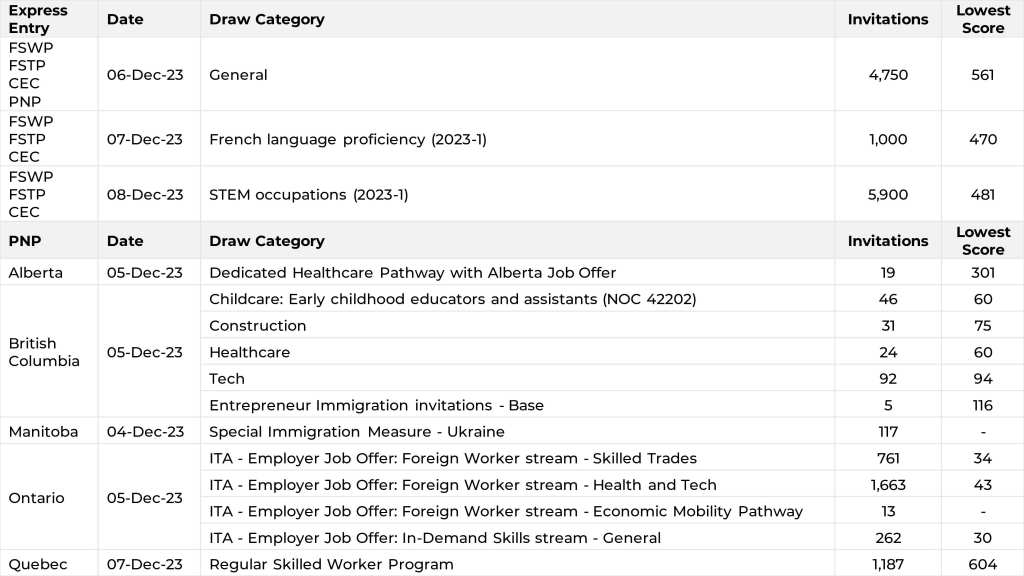
Express Entry and PNP Draws



 AVIO Immigration